

Bookkeeping vs Accounting: What’s the Difference & What Does Your Business Actually Need?

Bookkeeping vs Accounting is one of the most common areas of confusion for New Zealand business owners. Both are essential, yet they serve very different purposes. Understanding the difference helps you manage cash flow, stay compliant, and make smarter financial decisions.
Many small businesses start with basic records, but as the company grows, you eventually need more than simple data entry. You need clarity, interpretation, planning, and guidance that supports long-term decisions. That’s where structured bookkeeping and accounting begin to separate.
At GECA Chartered Accountants Limited, we see this confusion daily. Owners often aren’t sure when a bookkeeper is enough, or when an accountant becomes essential. This blog breaks down both roles clearly so you can choose the right support for your stage of business.
What Is Bookkeeping and How Does It Work?
Maintaining and documenting all financial transactions in a company’s original books of entry is known as bookkeeping. All of the company’s financial transactions are summarized and systematically arranged chronologically as part of the bookkeeping process.
A bookkeeper ensures:
- Every transaction is recorded correctly
- Bank accounts are reconciled
- GST records match IRD requirements
- Cash flow tracking stays organised
This work forms the foundation of all accounting tasks. Without consistent records, you cannot prepare reliable financial statements or meet compliance deadlines.
What Is Accounting and Why Does Your Business Need It?
Accounting goes beyond data entry. It interprets financial information, identifies trends, and gives you the insight you need to make informed decisions. This includes preparing tax returns, analysing performance, forecasting cash flow, and advising on risk or growth opportunities.
An accountant helps to:
- Prepare financial statements
- Manage tax obligations
- Provide strategic guidance
- Support funding and investment decisions
- Improve profitability and long-term planning
Simply put, bookkeeping records the transactions, while small business accounting in NZ explains what those numbers actually mean.
Bookkeeping vs Accounting: Key Differences Explained Clearly
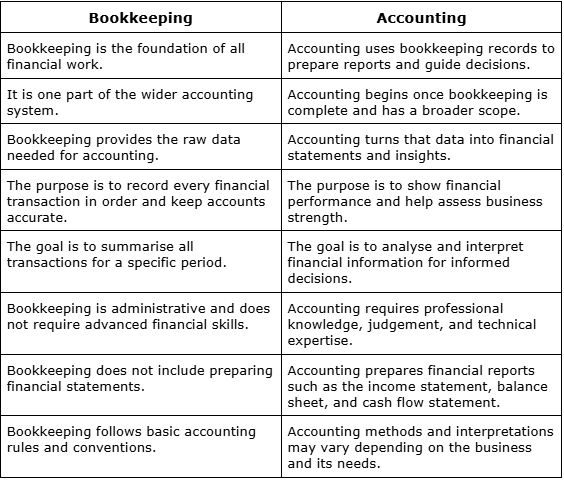
To understand Bookkeeping vs Accounting, think of one as recording the story and the other as interpreting it. Both work together, but each plays a distinct role.
Here is a clear comparison:
What Does Your Business Actually Need?
Having strong bookkeeping and accounting systems helps your business maintain accurate financial records, remain IRD-compliant, and make confident decisions throughout the year. These two functions work together, but the level of support you need depends on your transaction load, reporting needs, tax complexity, budget, and growth stage.
Below are five clear indicators showing whether your business requires bookkeeping, accounting, or both. Each point explains how both services support different stages of business operations, so you can decide what aligns best with your current needs.
1. Transaction volume
In New Zealand, high transaction volume commonly requires frequent bookkeeping services. This is due to the fact that every sale, expense, payroll entry, and GST-related movement has to be recorded correctly and without fail. Bookkeepers maintain accuracy and organisation, which in turn eliminates the risks of missed entries and reconciliation issues that could affect your cash flow and tax returns.
When transaction volume grows, accounting becomes equally important. Accountants analyse trends across those transactions, identify profit or loss patterns, and provide deeper insight into how your spending and sales performance influence your long-term financial direction. This combination helps owners make decisions grounded in real numbers rather than assumptions.
2. The complexity of financial reporting
Businesses with straightforward operations may only require bookkeeping for recording transactions and preparing basic summaries. Bookkeepers keep the financial data accurate and structured so the information is ready whenever you need to review cash flow or prepare GST returns.
However, specialized financial reporting like income statements, balance sheets, forecasts, or departmental analysis necessitates knowledge of accounting. The accountants are the ones who analyze the data, point out the possible dangers, and make sure that the information aligns with the strategic planning. This more thorough analysis is very important when it comes to the decisions regarding budgeting, financing, setting prices, or even the growth of the company in the long run.
3. Tax compliance and planning
Basic tax processes such as GST, payroll, and expense tracking can be supported through consistent bookkeeping. Bookkeepers ensure your records match IRD requirements, reducing errors and keeping your filings smooth, accurate, and on time throughout the financial year.
More complex tax obligations need accounting guidance. Accountants help you plan for provisional tax, manage deductions, structure your business for efficiency, and resolve IRD queries with confidence. They ensure your long-term tax position is planned strategically, not managed reactively at year end.
4. Budget and resource availability
For start-ups and very small businesses, bookkeeping can be the most cost-effective option. It ensures every transaction is captured correctly, and it gives you a clean base to understand your income and spending before moving into higher-level financial planning or advisory work.
As your business grows, accounting becomes a valuable investment. Accountants help create budgets, monitor financial performance, and guide decisions about hiring, pricing, and expansion. Their insight helps you allocate resources effectively and avoid costly mistakes that often come from navigating financial decisions alone.
5. Growth and expansion plans
When your business is in early stages, bookkeeping provides the reliable record-keeping needed to understand how your operations are performing. Clean, structured books help you assess whether your current model is sustainable and where adjustments may be required.
During growth or expansion, accounting becomes essential. Accountants provide forecasting, compliance support, financial modelling, and structural advice that protects your business from risk. This ensures you enter new markets, open new locations, or scale operations with a financial plan that is accurate and future-ready.
GECA Chartered Accountants Limited: Your Trusted Financial Partner
GECA Chartered Accountants Limited helps business owners understand what support they genuinely need by simplifying Bookkeeping vs Accounting and providing clear, practical guidance. Our fixed-fee structure, Xero expertise, and personalised approach make financial management easier, more transparent, and fully aligned with your long-term goals.
Our approach includes:
- Clear communication
- Practical, actionable advice
- No hidden fees
- Unlimited support
- Trust-based, long-term relationships
GECA Chartered Accountants Limited is ready to help you stay compliant, plan confidently, and strengthen your financial foundations. If you want reliable bookkeeping or expert small business accounting NZ support, book your consultation today and experience a smoother, more structured path to long-term financial success.
Conclusion
The difference between bookkeeping and accounting becomes clearer as your business grows and your financial needs shift. Understanding how each function supports compliance, clarity, and long-term decision-making helps you choose the right structure to keep your business stable, organised, and future-ready in the New Zealand environment.
PlusOne Accounting Packages is a fixed fee solution provided by GECA Chartered Accountants Limited, an innovative accounting & bookkeeping firm based in Grey Lynn, Auckland. Contact us now for a free initial consultation and discover how a PlusOne Accounting Package & other services that can support your financial success.